AI can grow the pharma pie twice: new drugs, and more months on the ones that work
Written by: Bernard Louvat
Role: CEO & Founder
Created at:
Article
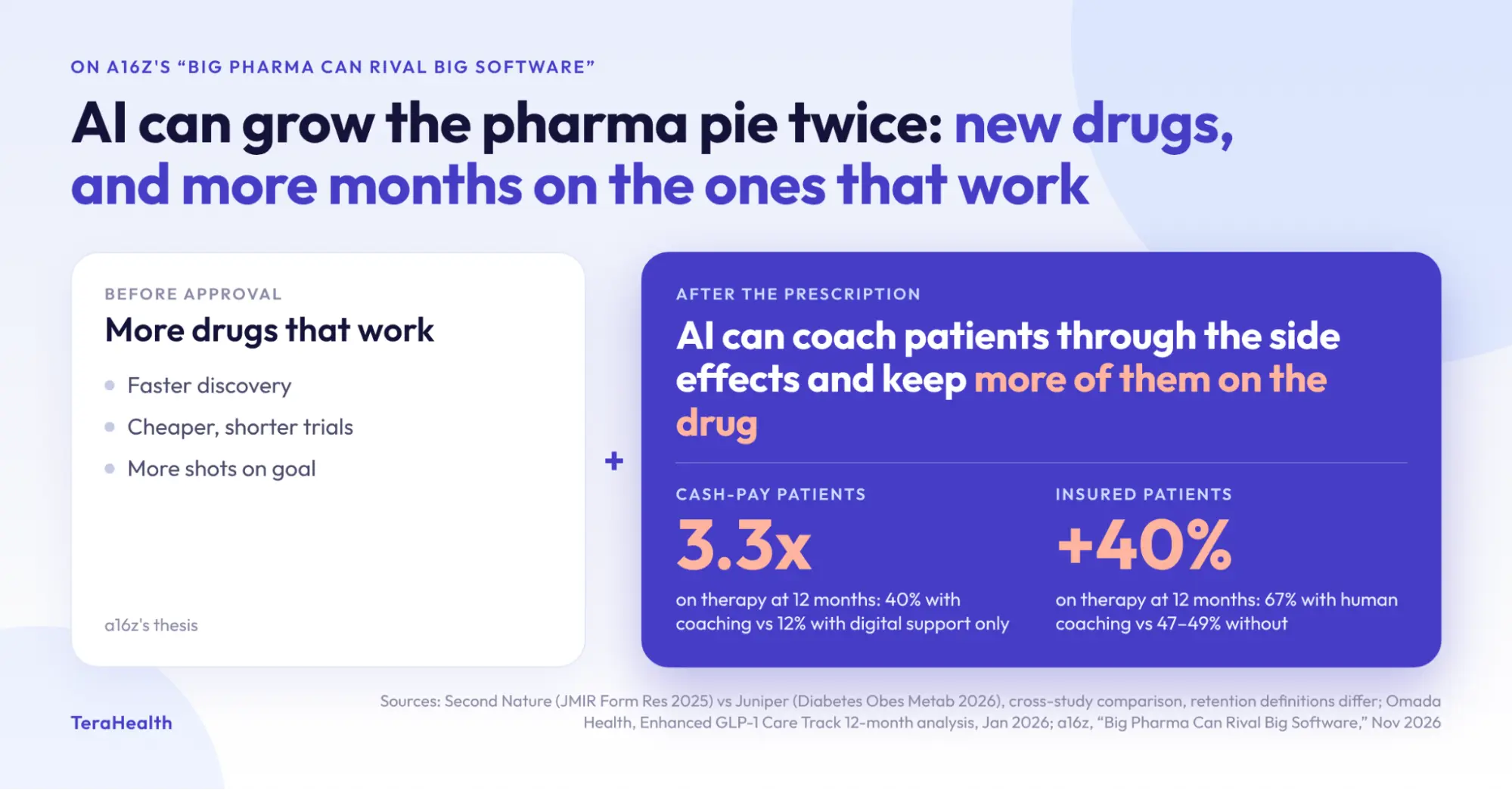
a16z published a piece today arguing that big pharma can rival big software, and that AI will make pharma even bigger. It opens with Eli Lilly, now worth more than a trillion dollars, mostly on the back of its GLP-1 drugs.
I agree with the argument. I also think it counts only half of the opportunity. The piece is about what AI does before a drug is approved. The other half is what happens after the prescription, and for GLP-1 adherence the numbers there are just as large.
What a16z gets right
The a16z authors describe pharma as "a hit business in drug development and an annuity business once a drug succeeds." A few blockbusters carry most of the revenue, and the big ones now look like big software companies. They write that Lilly's injectable GLP-1s, Mounjaro and Zepbound, did nearly $40B in 2025, roughly what Salesforce did in the same period.
Their case for AI is about making the hits more repeatable. Better models for picking targets and designing molecules, faster literature review, smarter trial design, quicker patient recruitment. More shots on goal at a lower cost per shot. If that works, investors may start to value a pharma company's discovery engine, and not only the drugs already on the market.
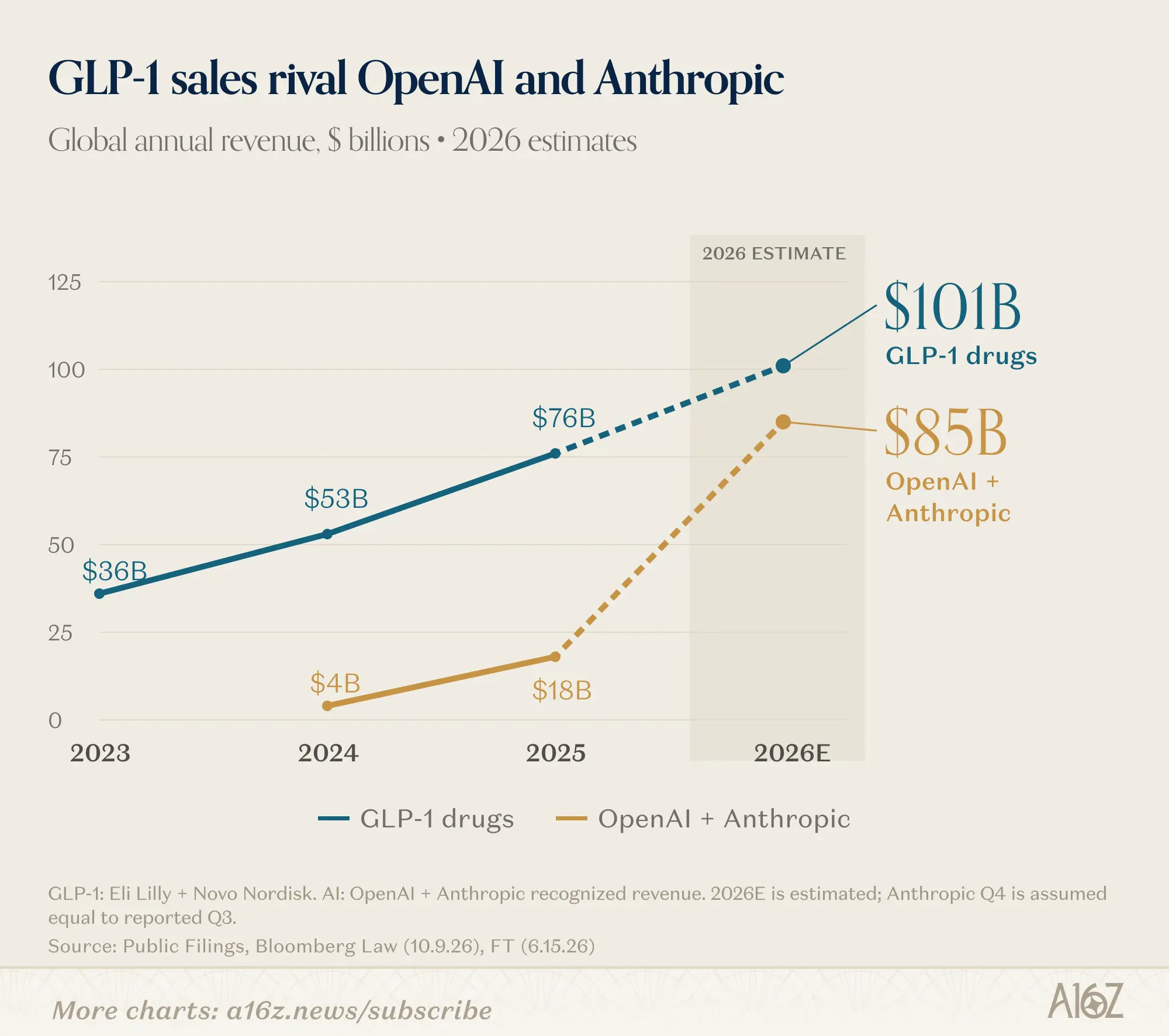
Source: a16z, Big Pharma Can Rival Big Software, November 2026.
The annuity only pays while patients take the drug
An annuity is a stream of payments over time. For a drug, that stream is patients refilling month after month. On GLP-1s, most of them stop:
- 64.8% of US adults without type 2 diabetes stopped their GLP-1 within a year, in a study of 125,474 patients (Rodriguez et al., JAMA Network Open, January 2025).
- Only 1 in 12 people were still on a GLP-1 for obesity at three years (Prime Therapeutics, June 2025).
- 30% of patients stopped within four weeks, before reaching the target dose (Blue Cross Blue Shield Association, May 2024).
A better molecule raises the ceiling on what a drug can earn. Persistence decides how much of that ceiling shows up.
Why patients stop in the first weeks
The first months are the hardest. In the Wegovy trials, 44% of patients had nausea, against 16% on placebo, and 24% had vomiting, against 6% (Wegovy prescribing information, Table 3). Each dose increase can bring the symptoms back. Patients also have to change how they eat when they suddenly aren't hungry, and protect their muscle while they lose fat. In the STEP 1 trial, about 38% of the weight lost was lean mass (joint nutrition advisory, Obesity, 2025).
None of this is solved at the prescriber visit. It's solved on a Tuesday night, three days after a dose increase, when someone feels sick and wonders whether to take the next shot. That's where patients need help, and it's where most programs have nothing to offer. The 11 GLP-1 side effects to plan for in the first 12 weeks.
Coaching keeps more GLP-1 patients on therapy
Two sets of data show what coaching does to 12-month persistence.
Cash-pay patients: 3.3x as many still on therapy. In a self-pay program with registered dietitian coaching, 40% of patients were still active at 12 months (Second Nature, JMIR Formative Research, 2025). In a self-pay digital service, 12% met the study's adherence bar at 12 months (Juniper Germany, Diabetes, Obesity and Metabolism, 2026). These are two separate studies with different retention definitions, so read the gap as a direction rather than a precise effect.
Insured patients: about 40% more still on therapy. Omada reports 67% of members in its enhanced GLP-1 care track still on therapy at 12 months, compared with 47% to 49% in a published comparison group without its program (Omada Health, January 2026).
Both results come from human coaching. The work itself is daily, personal and repetitive: what to eat tonight with nausea, how much protein, whether to train today, what to do about constipation. That is exactly the kind of work AI can now do for millions of patients at once, with clinicians setting the rules and human coaches stepping in where a person helps. This is what an AI-native service looks like in healthcare.
Who earns more when a patient stays
Every company around the drug earns more when a patient stays on it another month. The manufacturer sells another month of the drug. The D2C telehealth brand keeps the membership. The pharmacy fills the refill. And the patient gets the result they started for, since most of the weight loss comes after the first months.
So AI can grow the pharma pie twice. Before approval, by making it cheaper to find drugs that work. After the prescription, by keeping patients on the drugs that already work. The first takes years to pay off. The second can start with the patients already on therapy today.
What we're building at TeraHealth
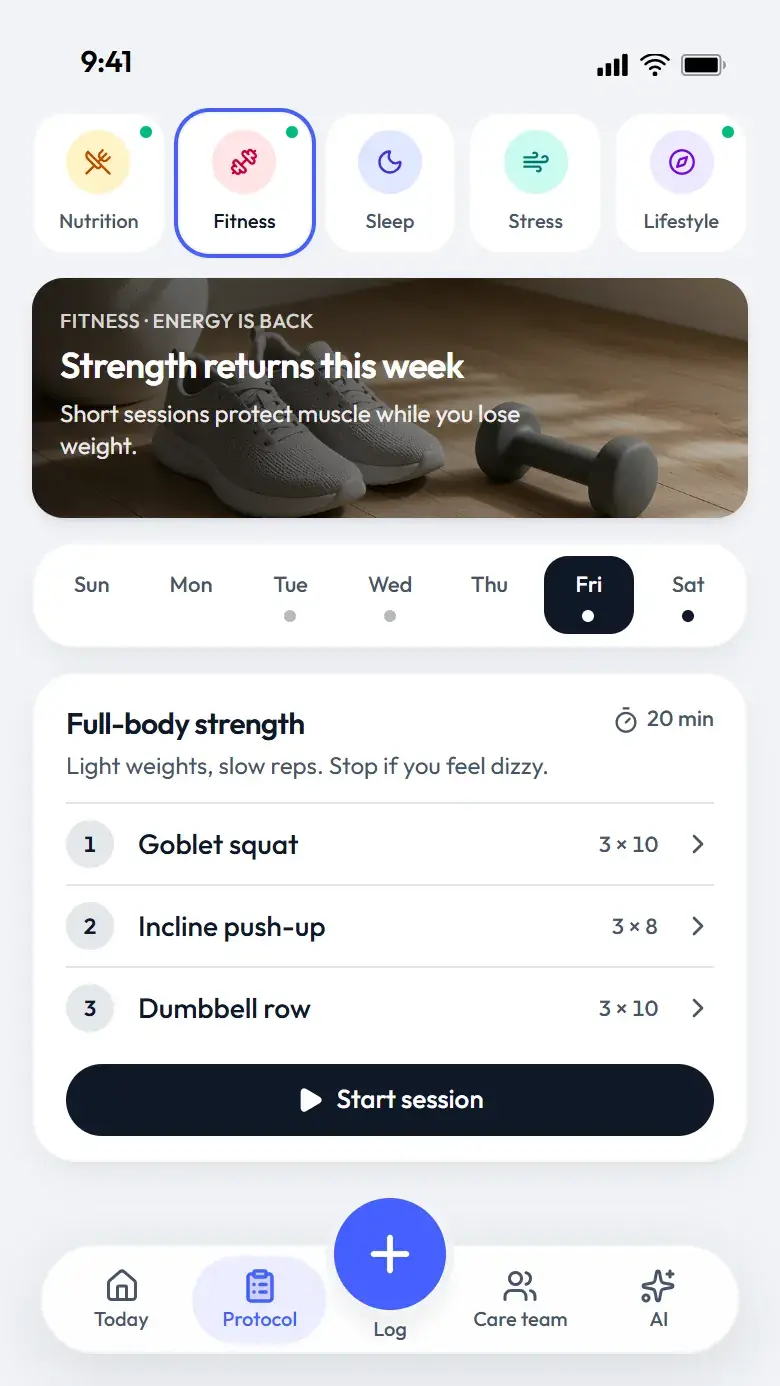
TeraRx, the drug coaching platform, starts with TeraRx for GLP-1. It coaches patients through the side-effect weeks on food, protein, training, sleep and stress, under our partner's brand. When a patient logs nausea after a dose increase, the plan switches to easy meals and a short walk replaces the workout that day.
The coaching is lifestyle only. TeraRx is not a pharmacy. It never prescribes, dispenses or changes the dose, and dose questions go back to the prescriber. Licensed dietitians sign off the food and supplement rules, certified personal trainers sign off the fitness rules, and our clinical lead, an MD, approves the rest.
Partners can have us run it for them with TeraRx Managed for GLP-1, with AI coaching or AI plus human coaches, or build it into their own app with the TeraRx API & SDK for GLP-1.
Hormone therapy is next.
What to do next
If you sell, fill or make a GLP-1, start tracking months on therapy per patient, and look at where in the first 12 weeks your patients drop off. That's the number of AI coaching moves. If you want to see how it works for your patients, book a demo.
More articles like this
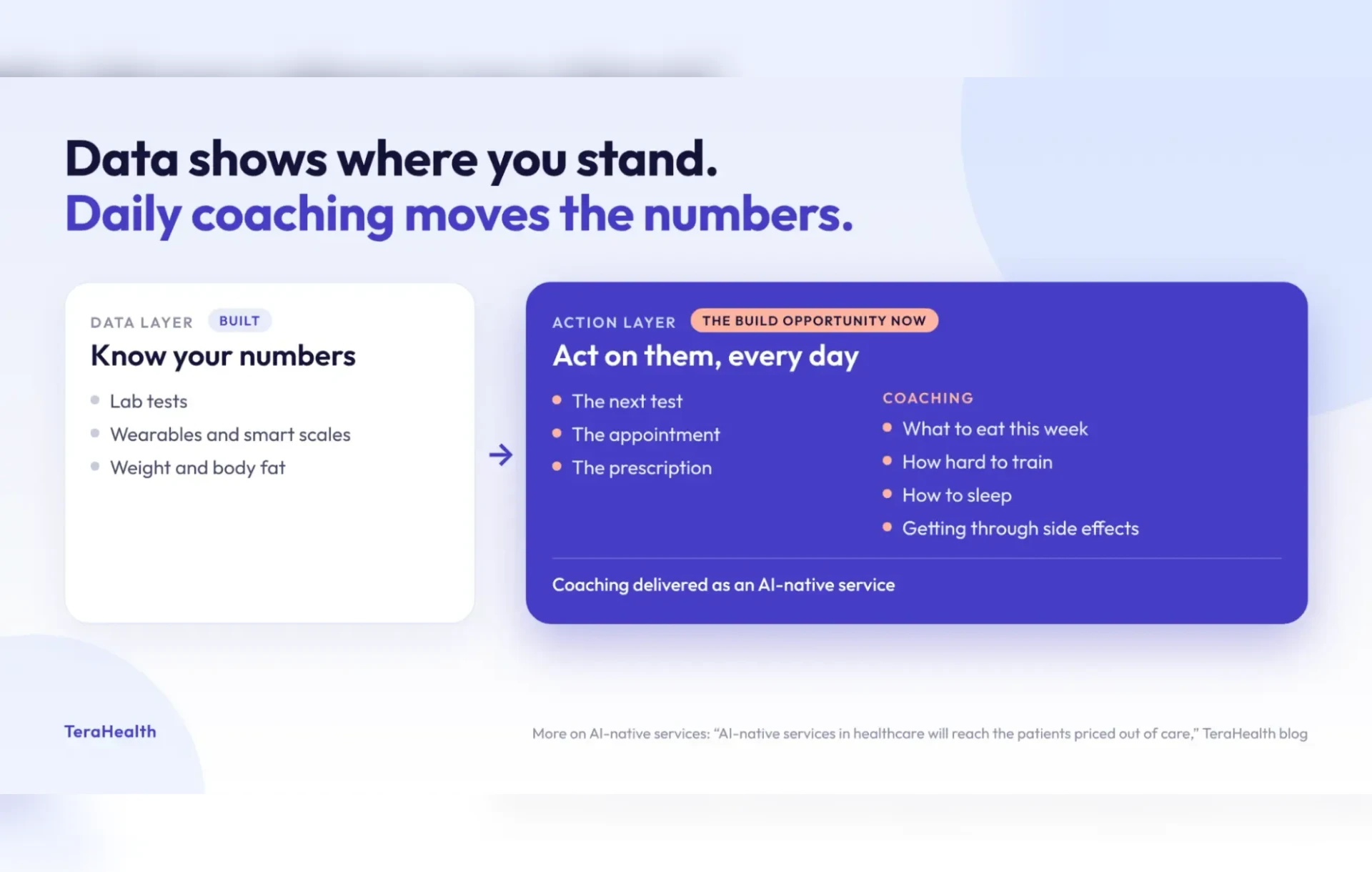
From knowing your numbers to changing them: why AI health coaching belongs in the action layer
Bernard Louvat
a16z says the opportunity is helping people act on their health data. Personalized AI health coaching is how they act every day, starting with GLP-1.
Industry insights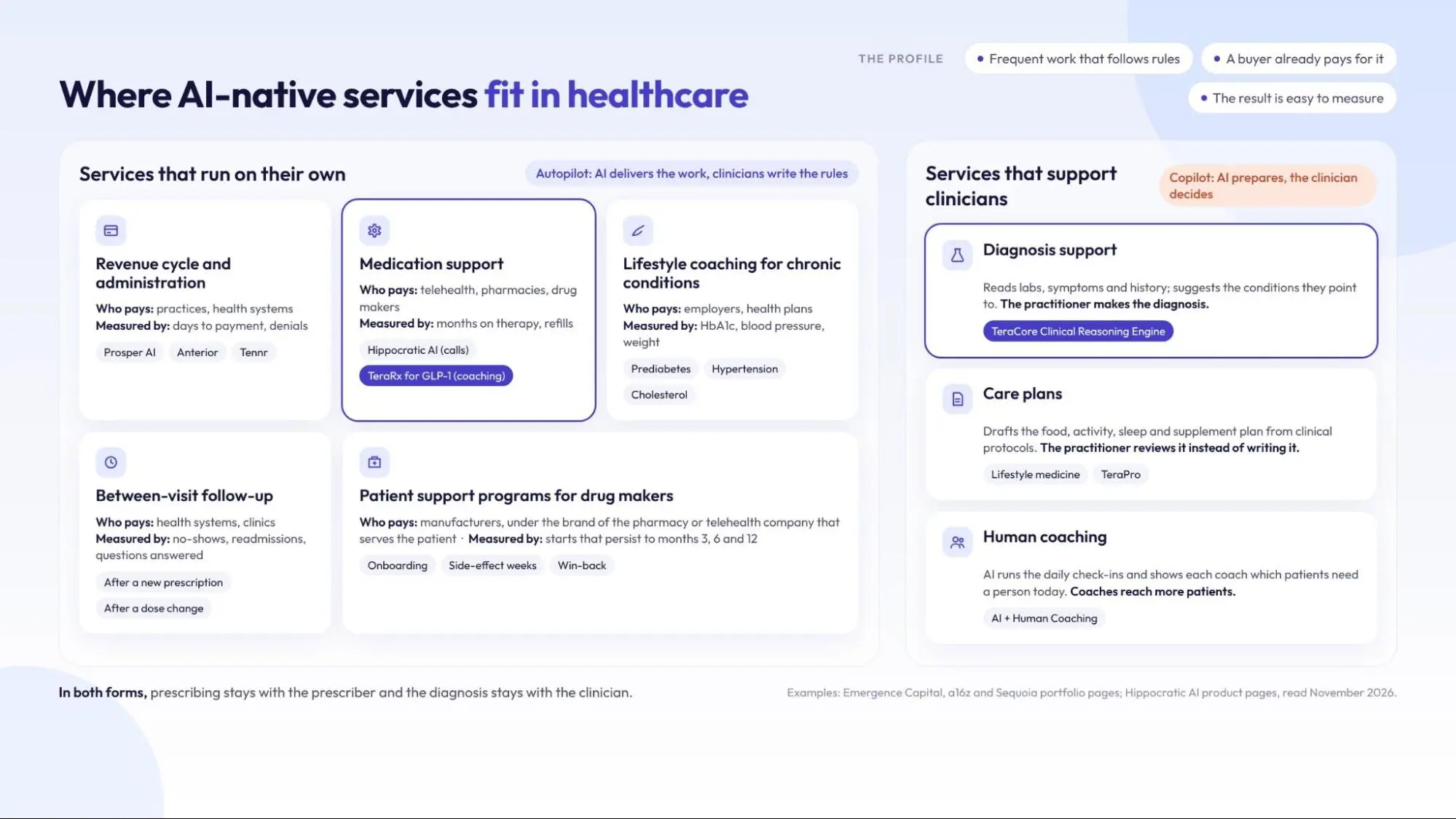
AI-native services in healthcare
Bernard Louvat
Much of healthcare is service work priced by the hour. AI-native services can bring that work to every patient, starting with GLP-1 coaching.
Industry insights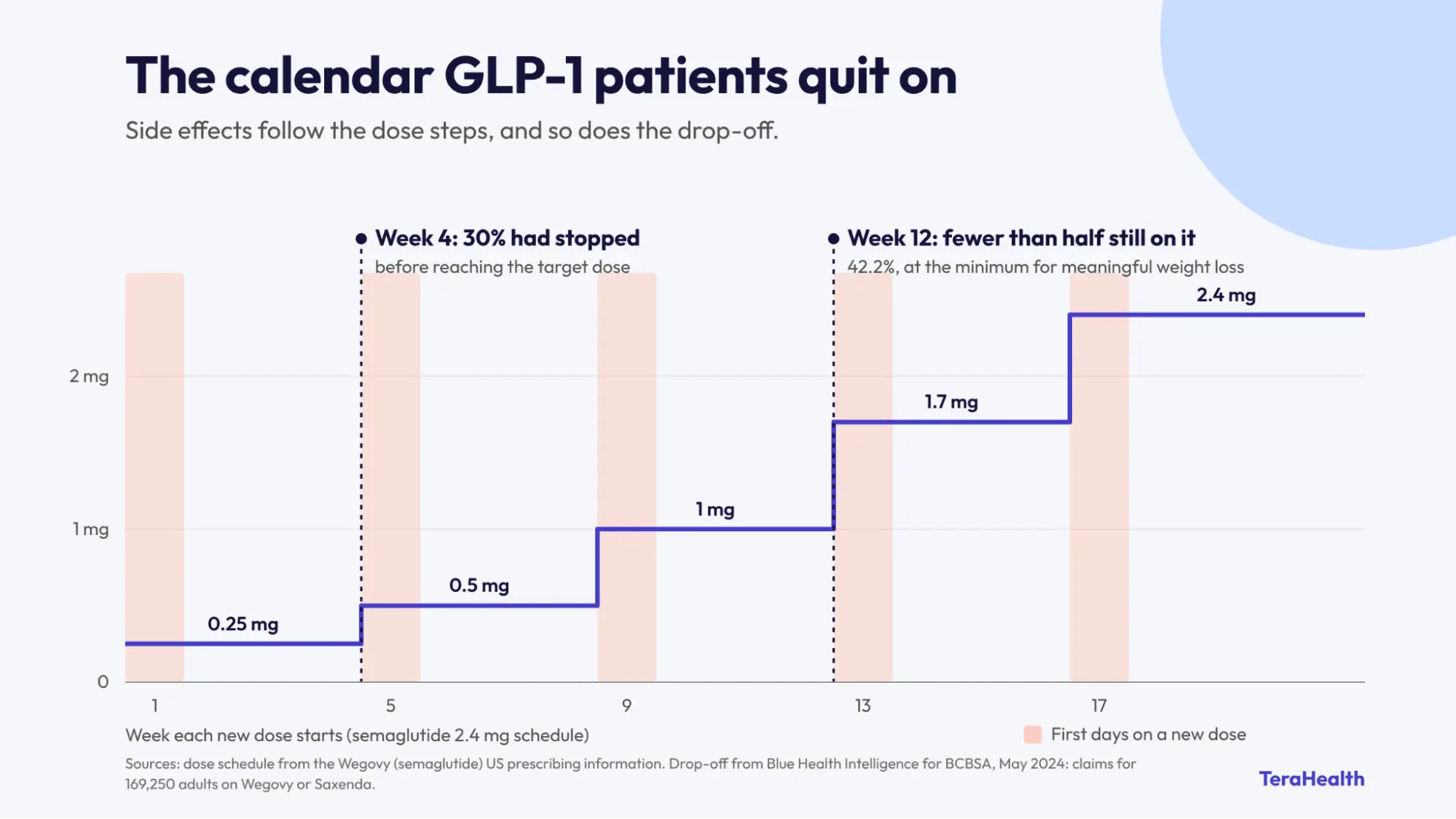
The 11 GLP-1 side effects to plan for in the first 12 weeks, and how coaching helps patients stay on therapy
Bernard Louvat
GLP-1 side effects follow the dose schedule, and so does the drop-off. Here is when and why patients stop, and how to manage GLP-1 side effects week by week.
Patient engagement and retention