AI-native services in healthcare
Written by: Bernard Louvat
Role: CEO & Founder
Created at:
Three days after a dose increase, a patient on a GLP-1 feels sick, tired and unsure whether to keep going. A nutrition coach and a trainer could get them through the week. At $150 to $300 a month on top of the medication cost, many patients never get GLP-1 coaching at all, and they quit.
That gap is everywhere in healthcare. A lot of what keeps patients well is service work done by people: coaching them through a new drug, answering questions between visits, following up when they go quiet. It's priced by the hour, so it reaches the patients who can pay for it or whose plan covers it, and skips the rest.
We think a new kind of company will close that gap. Investors have started calling it the AI-native service, and AI-native services in healthcare are where it matters most.
What an AI-native service is
Emergence Capital named the category. An AI-native services company "uses AI to deliver complete services, not software, faster, and better than traditional providers. The customer buys an outcome, not a tool." In March 2026, Sequoia's Julien Bek put it another way. "A copilot sells the tool. An autopilot sells the work." He argued that the next $1T company "will be a software company masquerading as a services firm," and that autopilots should start with work a buyer already outsources, because the budget line exists and the buyer is already paying for an outcome: "The outsourced task is the wedge." Coaching for GLP-1 patients passes that test. Telehealth companies and pharmacies already buy it from outside providers rather than build it.
The difference matters in healthcare. A software tool still needs someone to use it. An AI-native service shows up with the work done: the plan written, the patient coached, the follow-up sent, with clinicians approving the rules it runs on.
The category is no longer a thesis. Emergence Capital's market map of AI-native services, published by partner Jake Saper, tracks 77 companies across eight sectors, with healthcare revenue cycle among the first to be served. Almost everything written about these companies is about what the buyer saves. This article is about who the service reaches.
Why healthcare is the biggest opportunity
Five things make healthcare a natural fit.
- The work follows protocols. Much of everyday care is the application of known rules to a known situation: this drug, this dose, this lab value, this symptom. That's the kind of work AI handles well, when the rules are written and reviewed by clinicians.
- Buyers already pay for it. Telehealth companies, pharmacies, drug makers, employers and health plans already fund coaching, patient support and care management. The budget exists; the reach doesn't.
- The results are measurable. Months on therapy, refills, lab values and weight are tracked already, so it's clear whether the service works.
- Human-only services can't reach everyone. A service run only by people grows by hiring. Its price stays where it is, and many patients stay outside it.
- There aren't enough people to do the work. The AAMC projects a US shortage of up to 86,000 physicians by 2036, and WHO projects a global shortfall of 11.1 million health workers by 2030. The people already in the job are stretched: in 2024, 43.2% of US physicians reported at least one symptom of burnout, according to the AMA. Hiring alone won't close that gap: McKinsey finds that labor productivity in clinical care has fallen about 1 percent while the rest of the service economy rose more than 55 percent. AI-native services can take on the routine steps, so clinicians and coaches spend their time with the patients who need a person. Emergence's rule for the category is "Automate tasks, not people," and BCG's advice to health systems is the same: AI agents "should enhance and augment the human workforce."
Healthcare also sets a higher bar. A wrong answer can hurt someone, and buyers know it. When Bessemer and Bain surveyed 226 healthcare executives in September 2026, the returns so far were almost all in administrative work; 77% of clinicians override AI suggestions more than half the time, and 48% of payers will not fully reimburse care delivered by autonomous AI. So the AI-native services that win here will be the ones where clinical rules make the decisions, AI handles the routine steps, and clinicians step in where judgment is needed.
Where AI-native services fit in healthcare
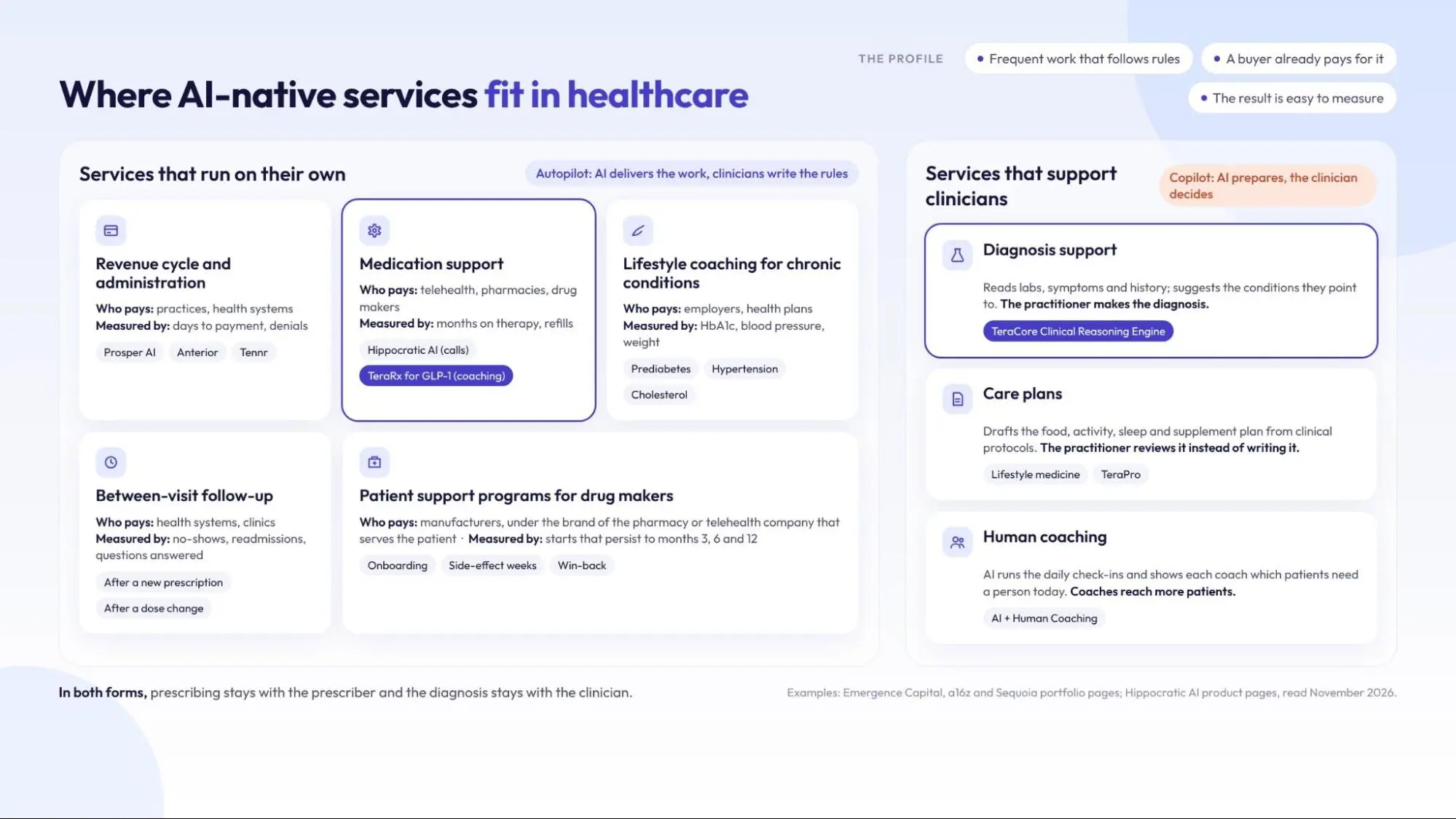
The best candidates share a profile. The work is frequent and follows rules, a buyer already pays for it, and success is easy to measure. We see them in two forms: services that run on their own, and services that support clinicians.
Services that run on their own. AI is good enough today to deliver these end to end. Clinicians write and review the rules, and a person steps in when something falls outside them.
- Revenue cycle and administration. Medical coding, billing and the phone calls behind them are already moving to AI-native providers. Sequoia points to coding as almost pure knowledge work. Emergence and a16z back Prosper AI, whose voice AI agents handle the calls a specialty practice's front office and billing staff used to make: scheduling, insurance eligibility and benefits checks, patient billing. Anterior, Sequoia's own example, does medical coding. Tennr, another a16z company, takes the referral faxes and does the intake work that follows.
- Medication support. Drugs with a titration schedule and predictable side effects, such as GLP-1s and hormone therapy, need coaching at specific moments. An AI coach can be there every day, and adherence, the months a patient stays on therapy, is the result everyone tracks. The budget exists: Hippocratic AI, backed by a16z and valued at $3.5 billion, sells adherence calls to drug makers, with onboarding calls through the first weeks and check-ins when side effects hit. Those calls keep the refill going. The next layer is coaching the patient through the weeks when they want to quit, with meals, protein and training that change what each day looks like, under the brand of the company that serves them.
- Lifestyle coaching for chronic conditions. Prediabetes, high blood pressure and high cholesterol respond to changes in food, activity and sleep. Clinical protocols already link each condition to those changes.
- Between-visit follow-up. Check-ins after a new prescription or a dose change, reminders and answers to common questions keep patients engaged when no one is scheduled to see them.
- Patient support programs for drug makers. Manufacturers already pay for programs that help patients start and stay on a therapy course, under the brand of the pharmacy or telehealth company that serves them. -Support for clinicians. Here the AI prepares the work and the clinician makes the call. Care gets delivered faster and more consistently, and the judgment stays with the person accountable for it.
- Diagnosis support. Our TeraCore Clinical Reasoning Engine reads lab results, symptoms and history and, using clinician-reviewed rules, suggests the conditions they point to. The practitioner reviews the evidence and makes the diagnosis.
- Care plans. Turning a diagnosis into a plan for food, activity, sleep and supplements is routine work for lifestyle medicine practitioners. The service drafts the plan from clinical protocols, and the practitioner reviews it instead of writing it.
- Human coaching. In a coached program, the AI handles daily check-ins and shows each coach which patients need a person today, so coaches spend their time where it makes a difference and reach more patients.
In both forms, prescribing stays with the prescriber and the diagnosis stays with the clinician.
Our first proof: GLP-1 coaching
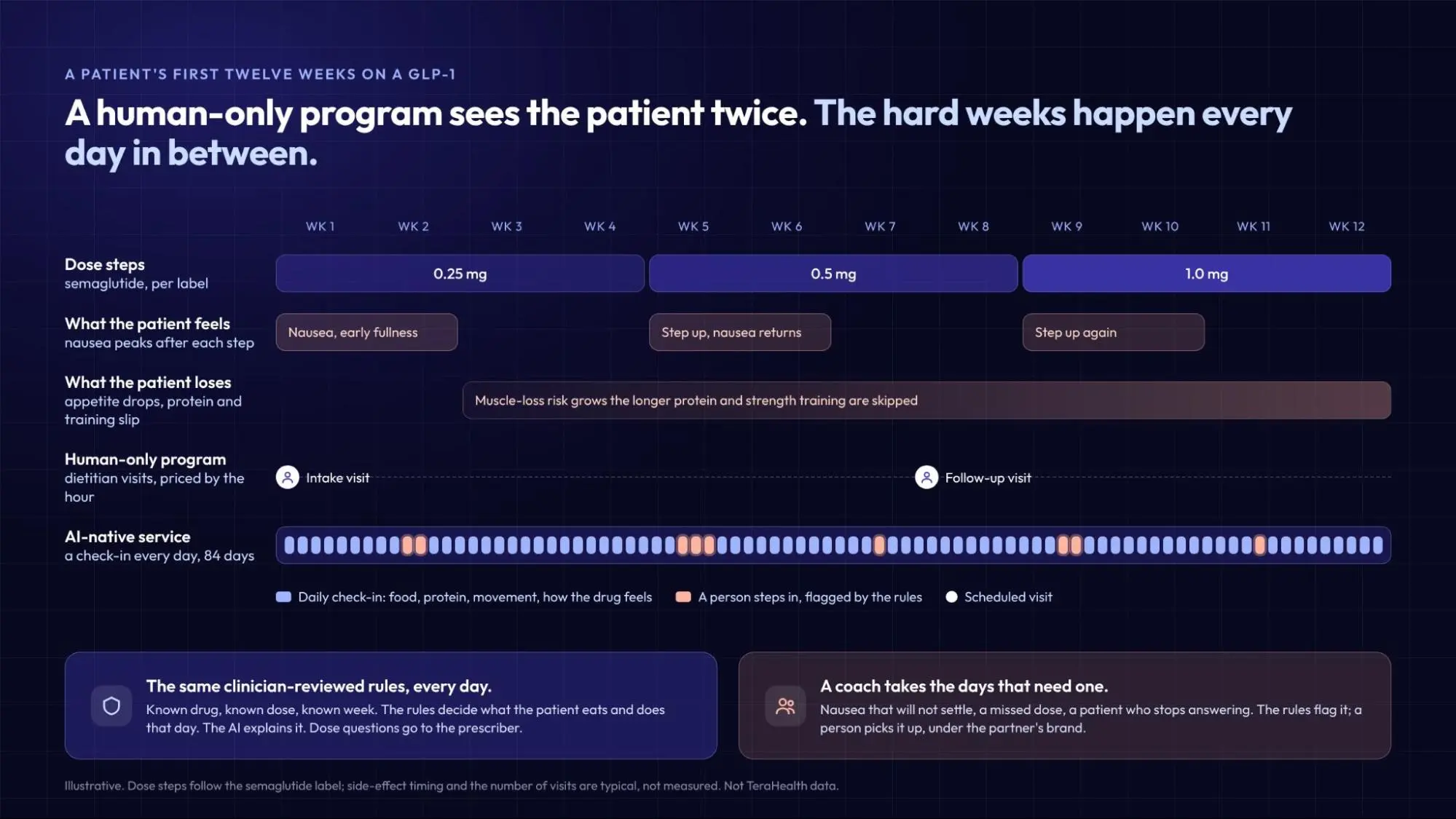
We started with GLP-1 coaching because GLP-1s, such as Ozempic, Wegovy and Zepbound, fit that profile almost exactly. The drugs slow the stomach and cut appetite, so side effects follow the dose schedule. Nausea, constipation and fatigue come back at each dose step, and that's when patients think about quitting. Fast weight loss also takes muscle along with fat, so strength training and protein matter as much as the meal plan.
Why do patients stop taking GLP-1s like Ozempic and Wegovy?
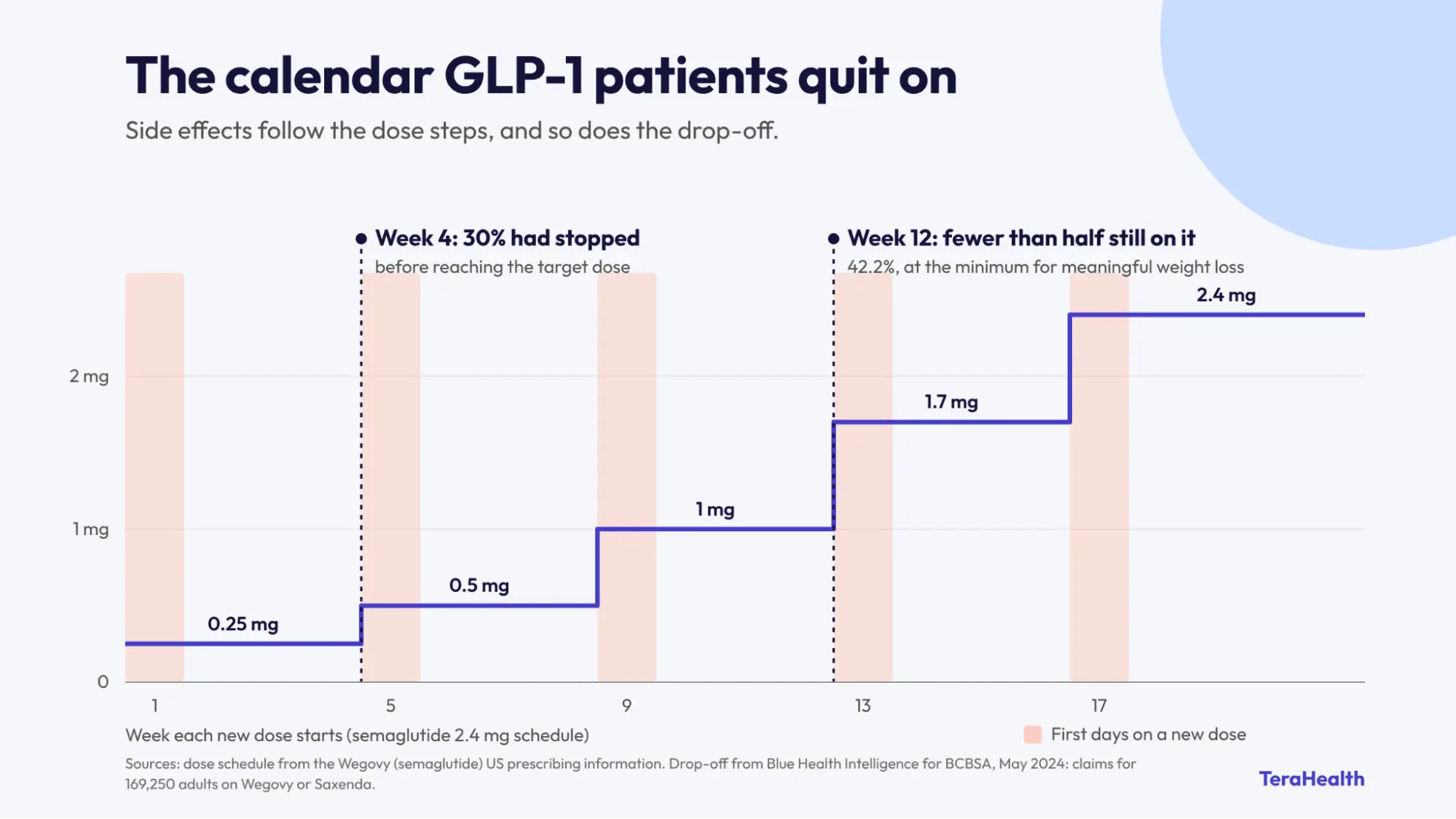
Most stop early. In a study of 125,474 adults published in JAMA Network Open in January 2025, 64.8% of patients without type 2 diabetes had stopped within a year. The Blue Cross Blue Shield Association found that 30% stopped within four weeks, before reaching the target dose, and fewer than half were still on the drug at 12 weeks. Those first weeks are when side effects hit hardest and patients have no one to ask, which is where coaching helps most.
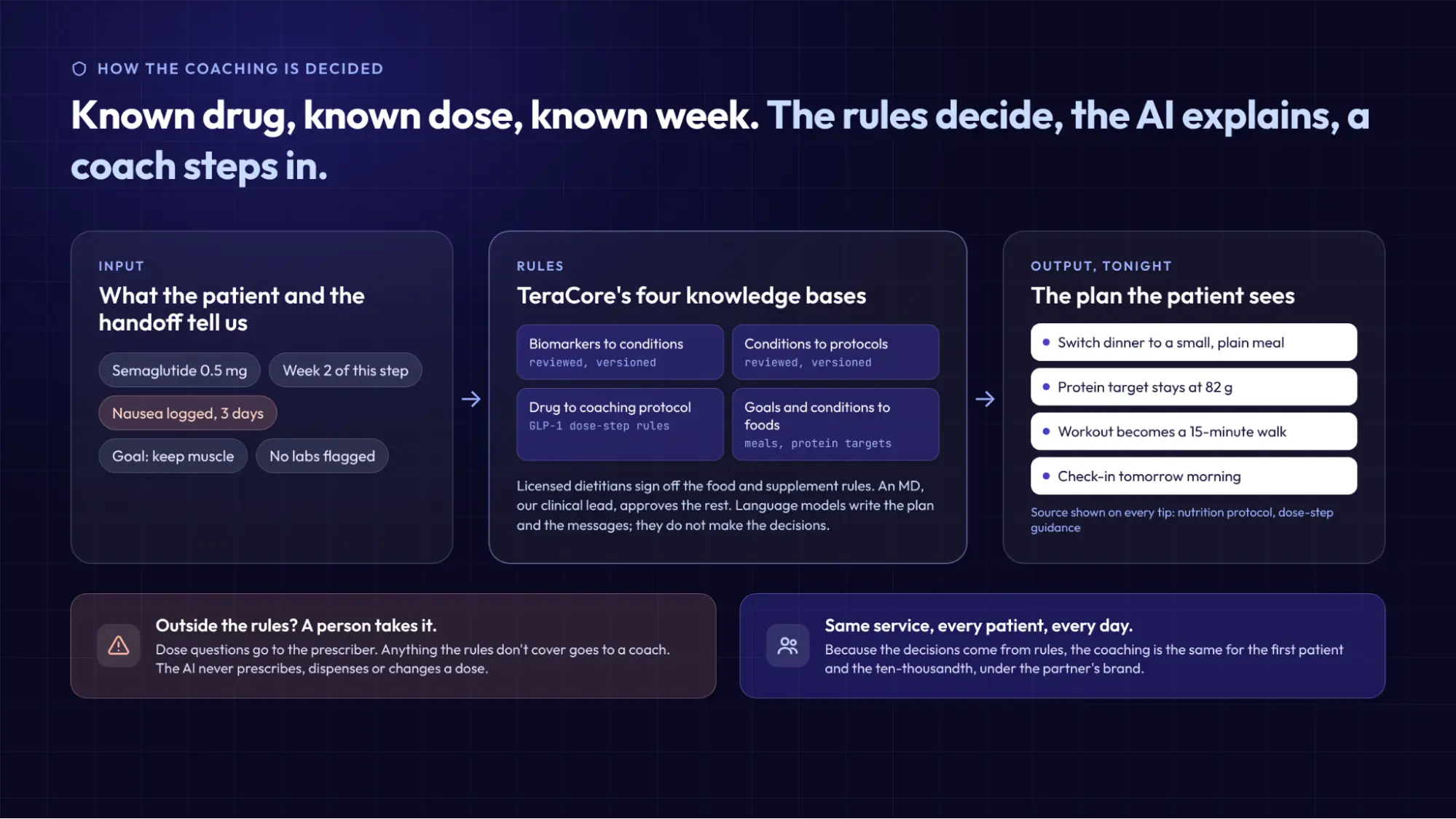
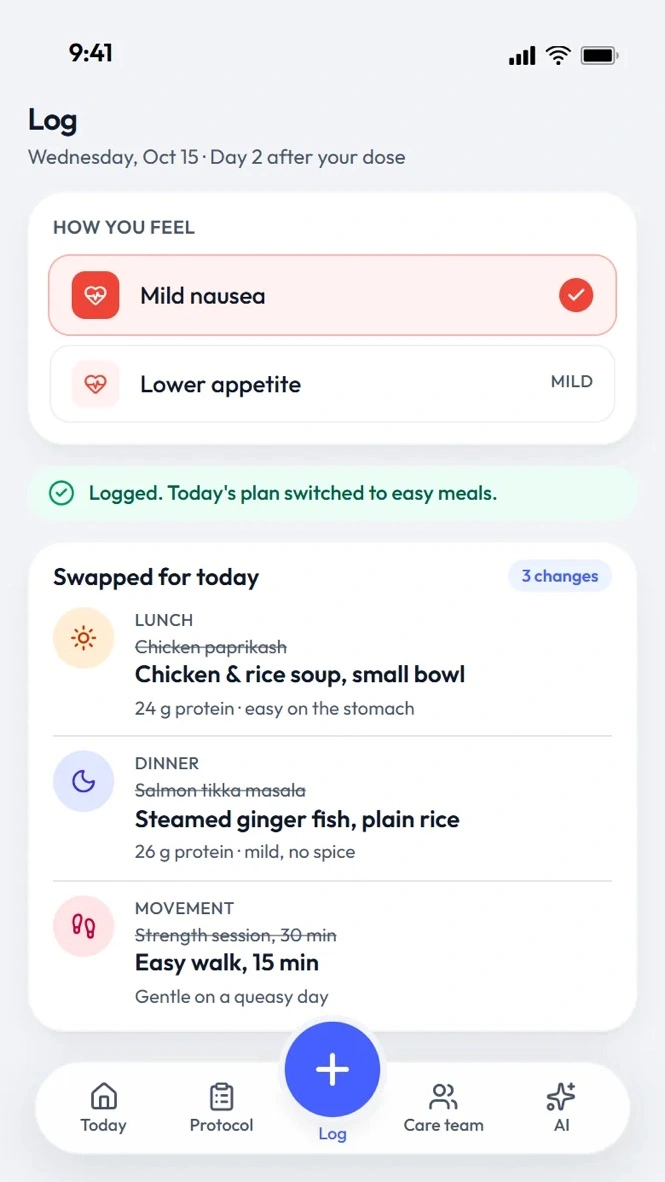
Because the drug, dose and week are known, most of the coaching can be decided by clinically reviewed rules: which meals to switch to, how much protein to eat, how hard to train, when to check in. Our rules sit in TeraCore's four knowledge bases, linking biomarkers to conditions, conditions to protocols, drugs to protocols, and goals and conditions to foods. Licensed dietitians sign off the food and supplement rules, certified personal trainers approve the fitness rules, and our clinical lead, an MD, approves the rest. Language models turn the rule outputs into plans and messages. The coaching is lifestyle only. We never prescribe, dispense or change a dose.
Does coaching help patients stay on GLP-1s?
Coaching lifts GLP-1 adherence. In Omada Health's 12-month analysis (January 2026), 67% of coached GLP-1 patients were still on therapy, against 47% to 49% of patients without coaching, when insurance paid for the drug. When patients paid cash, a dietitian-led program kept 40% on therapy at 12 months, against 12% for a digital-only service, in two separate studies (Second Nature, JMIR, 2025; Juniper, Diabetes, Obesity and Metabolism, 2026). The Blue Cross Blue Shield Association also found that each added provider visit raised the odds of reaching 12 weeks by about 60%.
The obstacle to adoption of coaching services is price. Dietitian-led GLP-1 programs often charge $150 to $300 a month. TeraRx for GLP-1 is priced so that a telehealth company or pharmacy can offer AI GLP-1 coaching to every patient it serves, every day, with a health coach and a fitness coach added for the patients who want a person in their corner. The AI prepares each patient's plan, history and logged symptoms before every check-in, so the coaches spend their time on the patient.
Telehealth companies, pharmacies and pharma brands offer it to their patients under their own brand. That lets them offer GLP-1 coaching to every patient they serve, and more patients coached means better GLP-1 adherence, with more patients still on therapy at months 3, 6 and 12.
We've built this before
Our team was pioneering AI-native services long before generative AI.
At TouchCommerce, later acquired by Nuance and now part of Microsoft, and at Nuance, we built AI service applications for customer support at some of the largest subscription brands in telecom and financial services, including AT&T, Verizon and Comcast. The AI handled customer conversations, and the customer service agents became coaches who trained it. Later the AI sat beside the agents, suggesting answers to customers' questions.
Keeping a subscriber from cancelling and keeping a patient on therapy turn out to be close cousins. TeraHealth applies the same playbook to patients, with a clinical rulebook behind it and coaches who step in where a person makes the difference.
What comes next
The same engine works for any drug whose side effects follow a schedule. Menopause hormone therapy is next, then testosterone. Beyond medication, TeraPro brings the model to lifestyle medicine practitioners: TeraCore's Clinical Reasoning Engine reads lab results and other patient data, suggests the conditions they point to for the practitioner to confirm, and builds a plan across six lifestyle protocols that adjusts as patients log symptoms. The practitioner reviews the plan instead of writing it.
Over time, we see AI-native services taking on the day-to-day work around physicians, dietitians, and health and fitness coaches, each one putting care within reach of more patients.
If you're building, buying or investing in AI-native services in healthcare, we'd like to talk. Contact us.
More articles like this
The 11 GLP-1 side effects to plan for in the first 12 weeks, and how coaching helps patients stay on therapy
Bernard Louvat
GLP-1 side effects follow the dose schedule, and so does the drop-off. Here is when and why patients stop, and how to manage GLP-1 side effects week by week.
Patient engagement and retention
Opening TeraRx for GLP-1 partners
Bernard Louvat
TeraHealth is opening TeraRx for GLP-1 to a first group of launch partners. It coaches patients through side effects under your brand. Coaching is about $19.99.
Product updates