Keep GLP-1 patients longer and grow what each one is worth
Most GLP-1 patients who cancel do it in the first months. They leave after a dose increase that made them sick, a payment that failed, a refill that came late or a plateau nobody explained. Each of those moments can be seen coming.
TeraRx watches for them. The AI coach starts the conversation, a human coach steps in when it matters, and your team sees the result in a dashboard built around two numbers: how long patients stay and what each one is worth to you.
With coaching, 40% of cash pay GLP-1 patients were still on therapy at 12 months, against 12% without.1
For GLP-1 programs sold through D2C telehealth, telehealth infrastructure, pharmacies and pharma brands.
1. Second Nature (digital weight management company, UK) and Eucalyptus/Juniper (telehealth, acquired by Hims & Hers in 2026).
Six moments when GLP-1 patients quit
The first two weeks
The box arrived three days ago and no dose is logged. The patient is nervous about the first injection.
Each dose increase
Nausea and fatigue return in the week after the dose goes up.
Activity drops
No app open for a week, weigh-ins stopped, an appointment missed.
Plateau, cost and delivery
The scale has not moved in three weeks, the price starts to hurt, or the refill is late.
About to leave
A payment fails, a card is about to expire, or the patient opens the cancel page.
The first 90 days
Nobody checks in at day 14, day 45 or day 90, so the patient never sees their own progress.
Retain, support and grow each patient
Retain
Retention rules spot the six moments above. The AI coach reaches the patient first and a human coach takes over when needed.
You track
Monthly cancellations, average months paid
Support
The AI coach answers food and side-effect questions at any hour. It answers billing and shipping questions too, once we have trained it on your FAQs during implementation. Dose questions go to your prescriber.
You track
Support cost per patient per month
Grow
Patients can upgrade to human coaching, move to a prepaid plan, or buy what you already sell: your other programs (hormone therapy, hair loss, dermatology, sexual health), supplements, groceries through Instacart and GLP-1 friendly meals. The upsell agent makes the offer at a moment that fits, such as a protein product in the week after a dose increase, and makes no offers to patients at risk.
You track
Revenue per patient per month
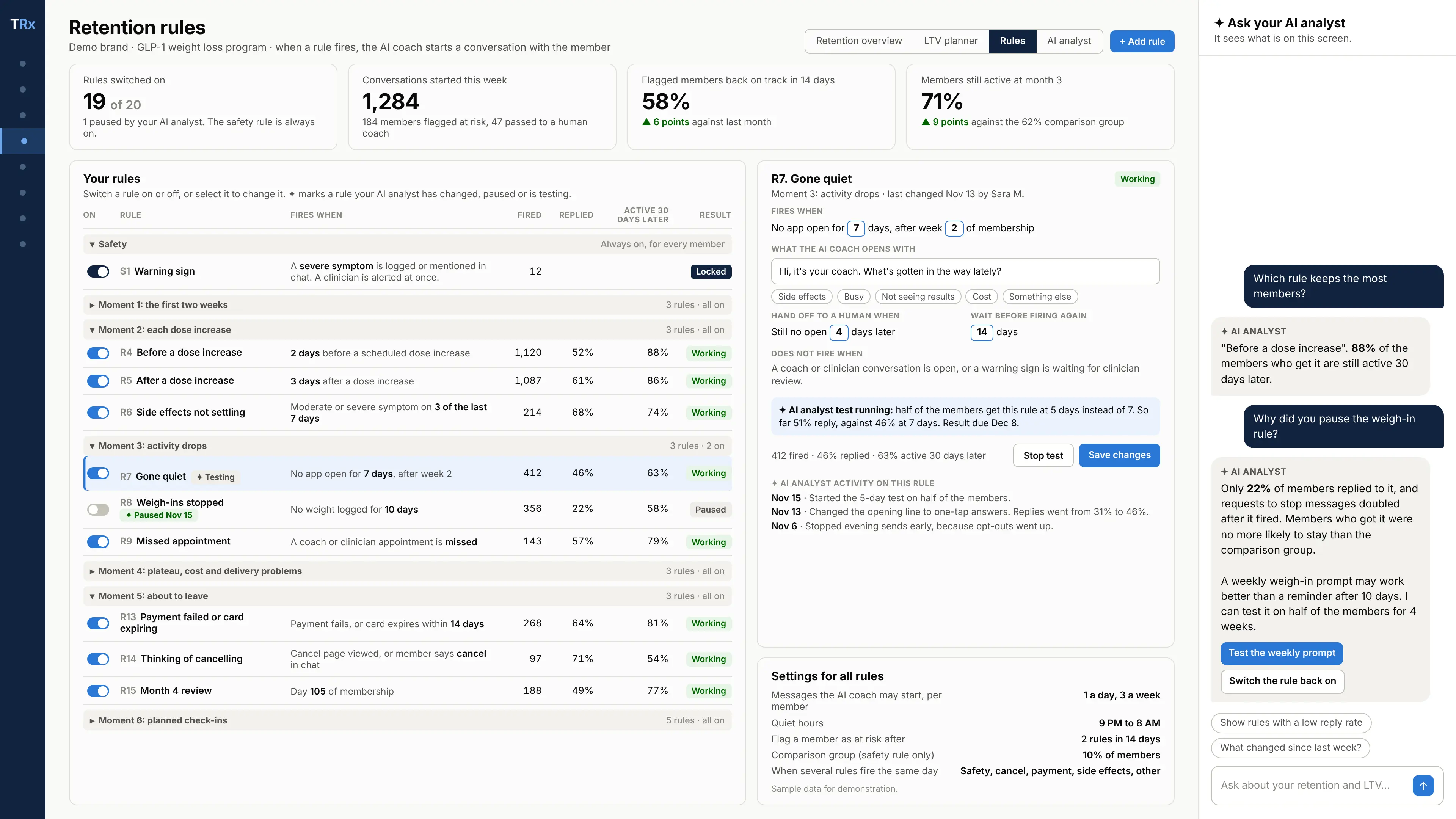
20 rules that start the conversation before the patient cancels
What your team controls
- Switch a rule on or off, change its numbers, and rewrite the AI coach's opening line.
- See each rule's results for the last 30 days: how often it fired, how many patients replied, how many were still active 30 days later.
- Set limits for every rule. By default the AI coach starts at most one conversation a day and three a week per patient, and none between 9 PM and 8 AM.
What happens after a rule fires
- 01Find out why. The rule usually says. When it doesn't, the AI coach asks one question with tap answers: side effects, busy, not seeing results, cost, something else.
- 02Fix that reason. Side-effect tips for the patient's drug and dose week. A one-tap card update. The new delivery date before the patient notices the delay.
- 03Bring in a person. A patient who triggers two rules in 14 days, mentions cancelling or doesn't reply goes on the human coach's at-risk list, with the rules that fired and the conversation so far.
- 04Follow up. The AI coach checks back two to three days later. If the patient is active again, the flag clears.
Limits that never change
- One safety rule is locked on for every patient. A severe symptom alerts a clinician at once and pauses every other rule for that patient.
- The AI coach never gives dose advice. Dose questions go to your prescriber.
- The cancel button always stays visible. A patient who reaches their goal is offered the Maintain plan and no save offer.
- The AI coach says it is an AI and offers a human in one tap.
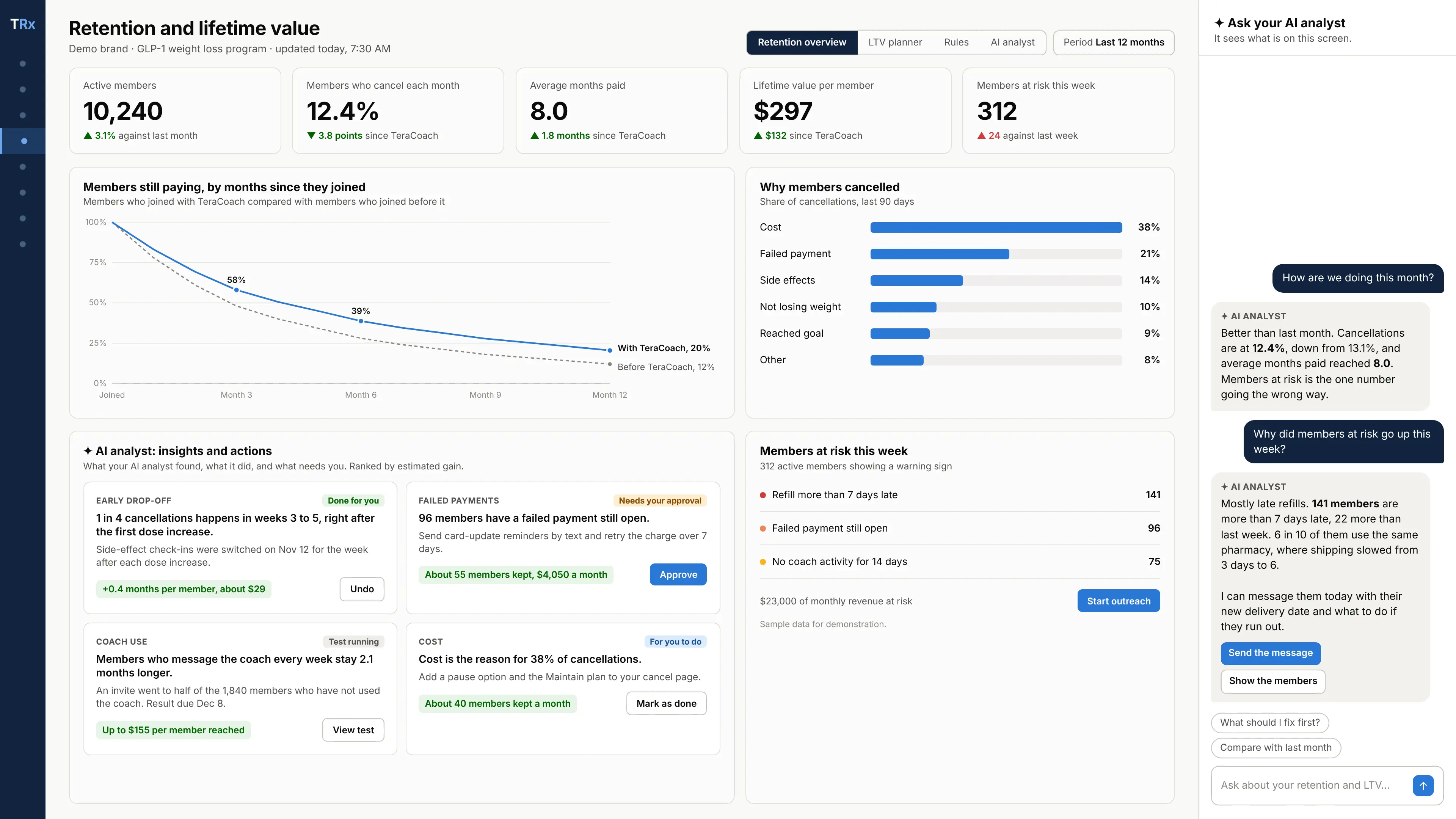
How long patients stay, why they leave and who is at risk this week
Headline numbers
Active patients, monthly cancellations, average months paid, lifetime value per patient, patients at risk this week.
Retention curve
Patients still paying by month since they joined, with TeraRx against without.
Why patients cancelled
Cost, failed payment, side effects, not losing weight, reached goal.
At risk this week
Patients with a late refill, an open failed payment or no coach activity for 14 days, and the monthly revenue they represent.
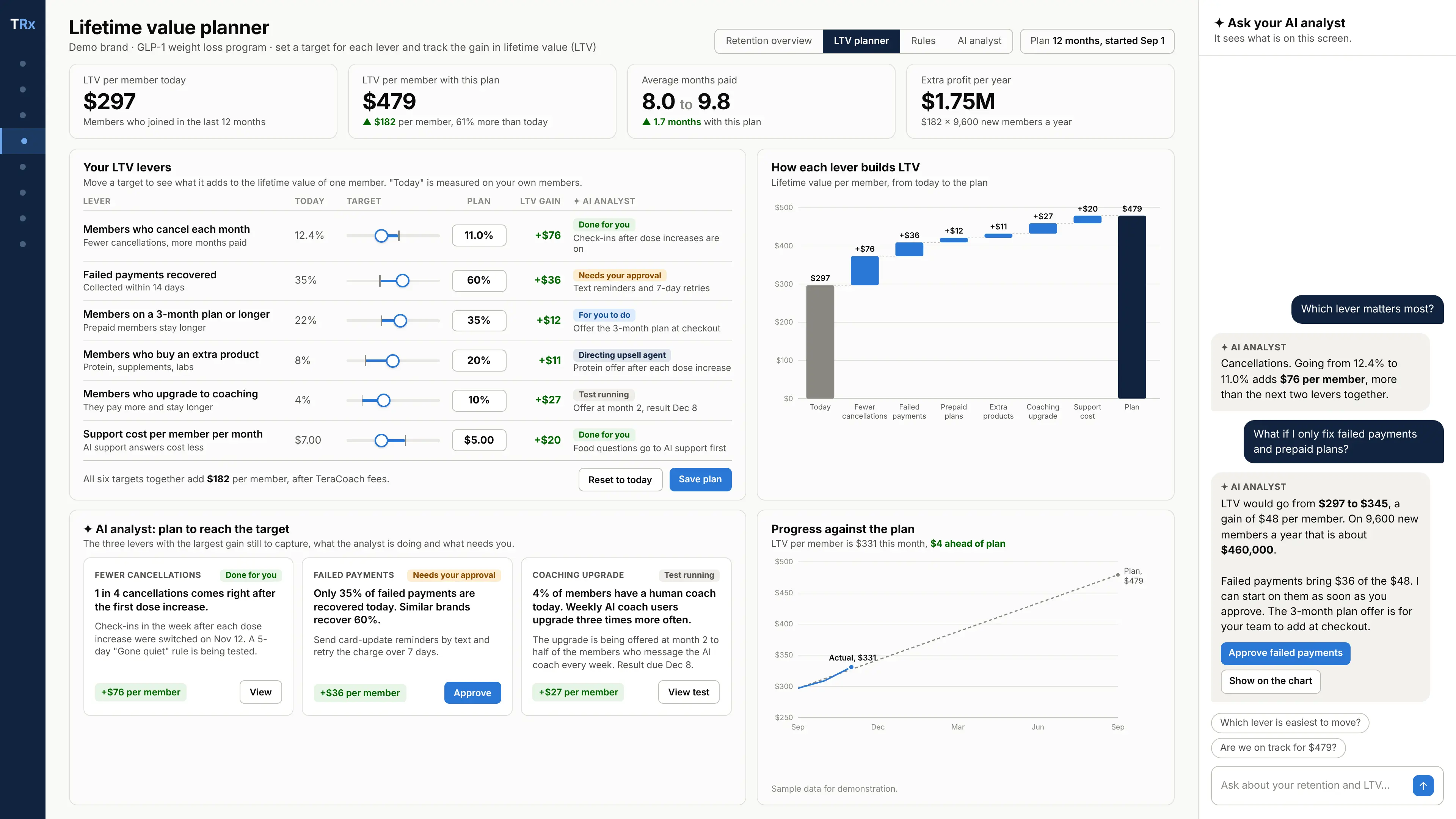
Set a target for each lever of lifetime value
| Lever | What moves it |
|---|---|
| Patients who cancel each month | Retention rules and coaching |
| Failed payments recovered | Card-update reminders and retries |
| Patients on a 3-month plan or longer | A prepaid plan offered at checkout |
| Patients who buy an extra product | Your own products, offered by the upsell agent |
| Patients who upgrade to human coaching | The upgrade offered to patients who use the AI coach every week |
| Support cost per patient per month | The AI coach answers routine questions first |
An analyst that tests, acts within your limits and reports every decision
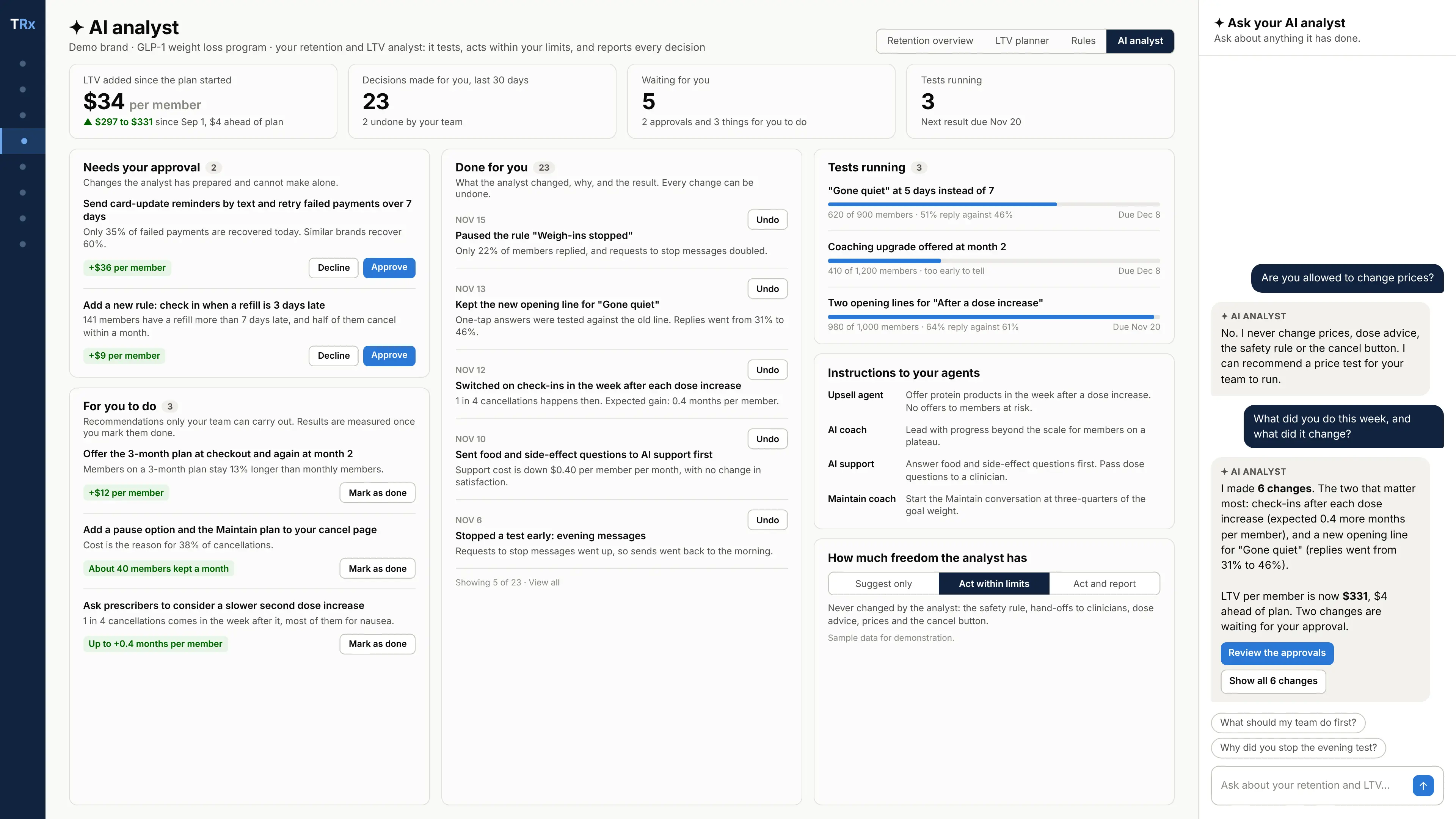
Done for you
Changes inside TeraRx, such as pausing a rule patients ignore or switching on check-ins after each dose increase. Each one shows the reason and has an undo button.
Needs your approval
Changes it has prepared and cannot make alone, such as retrying failed payments.
For you to do
Recommendations only your team can carry out, such as adding a pause option to your cancel page.
You choose how much freedom it has: suggest only, act within limits, or act and report. It never changes the safety rule, hand-offs to clinicians, dose advice, prices or the cancel button.
Every screen has a chat panel. Ask “Why did patients at risk go up this week?” and it answers from the numbers on the screen.
See your own numbers before you sign
You enter
What patients pay you each month and what the drug costs you. How many patients you have and how many are still paying after 12 months. Your prepaid plans. What you spend on support, clinician follow-up and marketing per patient.
You get
Your yearly revenue and contribution margin, before and with TeraRx. Months a patient keeps paying, for the AI coach, AI support and upsell, and human coaching. Extra profit per patient after our fees, with a low, expected and high case.
Projected from the numbers you enter. After launch, results are measured on your own patients.
Measured on your patients, against a comparison group
Baseline
Before launch we take 6 to 12 months of your data and agree your current cancellation rate and months paid.
Comparison group
A share of new patients, picked at random, go without the retention rules for a few months. Only the safety rule runs for them. If you prefer not to hold anyone out, we compare with similar patients from before launch.
Monthly report
Cancellations, months paid, extra products bought, support tickets resolved by AI and coaching upgrades, for both groups.
Timeline
Usage in month 1. An early signal on cancellations in months 2 to 3. A solid answer at month 6.
Three data feeds are enough to start
| Data | What it contains | Used for |
|---|---|---|
| Patient list | An ID code, sign-up date, sign-up channel, state | Retention by joining month |
| Subscription events | Start, renew, pause, resume, plan change, cancel and the cancel reason | Cancellations and why patients leave |
| Payments | Date, amount, type and status (paid, failed, refunded) | Revenue, failed payments and LTV |
Prescription fills and your cost list come next. They add late-refill warnings and LTV by drug, plan and channel.
How it arrives
A daily or weekly file or API feed, with 12 months of history at the start.
No names
ID codes only. No names, emails or addresses.
BAA first
A signed BAA before the first file.
If you run on a third-party telehealth platform, we connect to it and to your billing system. Where the platform lets outside software act, the AI analyst acts with your approval. Where it doesn't, the action reaches your team as a “For you to do” item with the exact steps.
We have kept subscribers for AT&T, Verizon and Comcast
Bring your cancellation rate and your price. We'll show you the six moments in your own program.
See why patients cancel, who is at risk this week, and what each one is worth.