I
API ONLY
Server-to-server REST API
You build the UI (user interface) inside your own application. Authentication via OAuth or API key. Modules return structured JSON your app renders natively.
API
Your coaches are good at coaching. What slows them down is building a personalized plan for each member from that member's data — and doing it consistently across a roster. Clinical Reasoning interprets the data; the protocol builders generate the plan; your coaches do what they do best.
Practitioner-supervised. Rule-anchored. Evidence-cited. HIPAA (Health Insurance Portability and Accountability Act)-compliant, BAA (business associate agreement)-ready.
15+ hours
saved per practitioner per week on interpretation and plan assembly
6
protocol domains generated per member, not a single generic curriculum
Cited
evidence behind every recommendation a coach delivers
A curriculum can be delivered to thousands. A plan built from one member's labs, session notes, health history and conditions has to be produced for each of them — which is where the model breaks.
TODAY
Members get a program with some branching, and coaches adapt it in conversation. The adaptation depends on the individual coach’s knowledge, and it isn’t reproducible across a roster.
Making it genuinely personalized would mean a clinician interpreting each member’s data and building each plan — which the unit economics of a coaching platform don’t support.
WITH TERA MODULES
Clinical Reasoning interprets each member’s biomarkers, symptoms, and history, returning findings with citations rather than a coach’s recall.
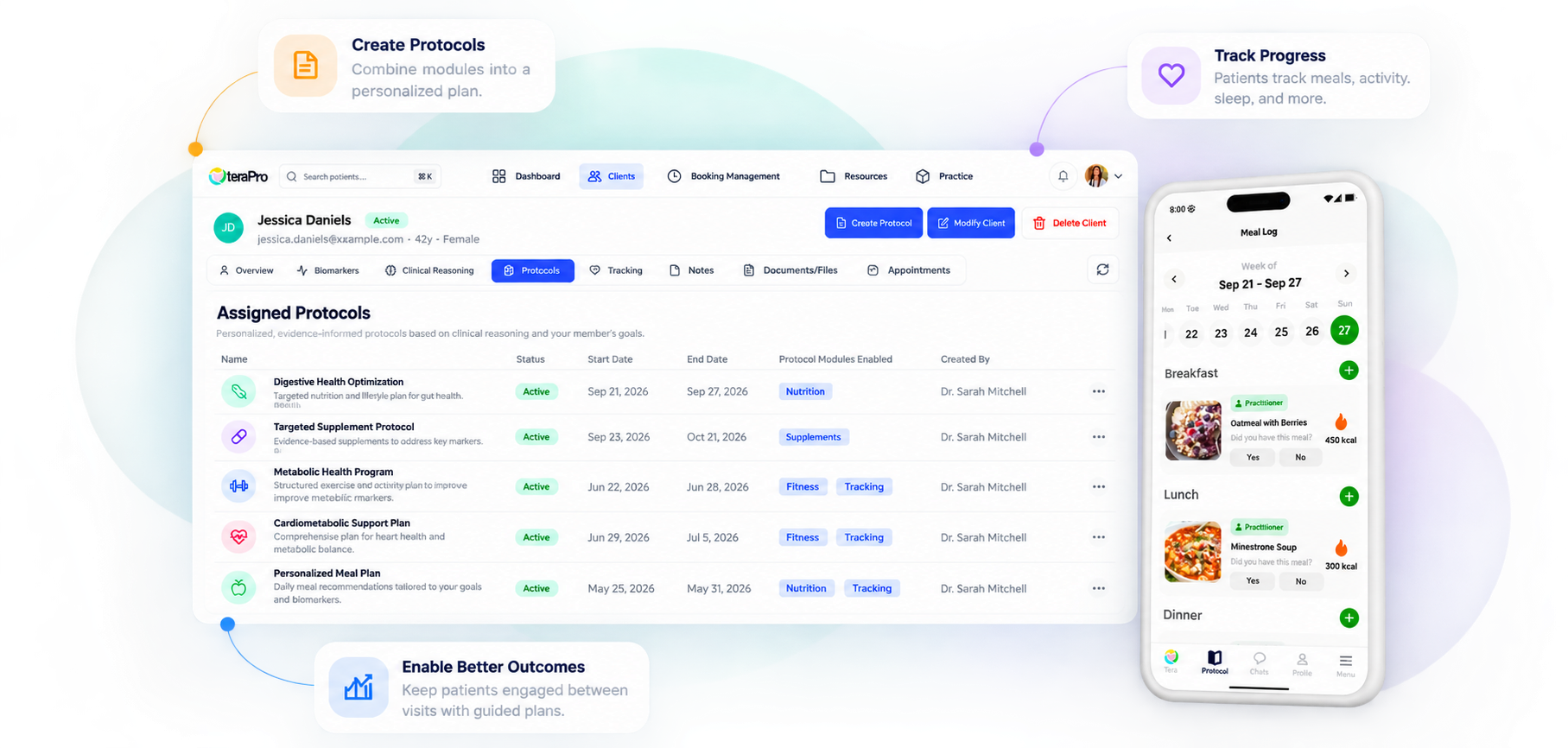
The protocol builders generate a personalized plan across six domains. A practitioner approves it, and your coaches deliver it — the same quality bar for every member on the roster.
The shift
From adapting a curriculum to generating the plan for each member.
Clinical interpretation, personalized protocol generation, and a patient-facing surface that keeps the plan running between coaching sessions.
Module 02
Interprets biomarkers, symptoms, health history, and conditions into structured findings with citations — giving every coach the same clinical starting point.
Module 03
Generates personalized nutrition plans from the member’s findings, goals, and health context — including foods, eliminations, and macronutrient targets.
Module 05
Builds individualized exercise protocols around the member’s goals, conditions, current capacity, and broader care plan.
Module 10
Delivers the approved plan between coaching sessions, guiding the member daily and keeping execution connected to the practitioner and coach.
All nine modules are available — these are the ones this use case starts with.
The practitioner stays in control. The modules interpret and assemble; your coaches focus on delivery, accountability, and the member relationship.
Step 01
Labs, intake, symptoms, health history, and wearable data pass into Clinical Reasoning through the API or your existing integration.
Step 02
The rules engine interprets the member’s data and returns structured findings with citations — consistently across the entire roster.
Step 03
The protocol builders generate a personalized plan across the relevant domains based on those findings and the member’s goals.
Step 04
A practitioner reviews and approves the plan. Your coach then delivers it with the clinical groundwork already done.
Clinical safeguards
Clinical defensibility is the precondition for embedding AI into any healthcare platform — three architectural pillars built to pass your compliance, legal, and clinical leadership reviews.
Tera AI generates; the licensed clinician approves. Every condition hypothesis, every protocol, every adjustment is reviewed and signed off before it reaches the patient.
Tera does not ask a language model to interpret biomarkers. A proprietary clinical knowledge base maps results and wearable metrics to functional ranges deterministically, then to conditions and protocols. The model only summarizes what the rules produced.
Three knowledge bases — biomarker to condition, condition to protocol, food to condition and health goal — with every mapping backed by peer-reviewed citations. Audit-ready and inspectable.
Clinical AI architecture
Rules produce the findings. AI communicates them.
Integration
Pick the integration depth that matches your engineering capacity and brand requirements. All three deliver the same clinical AI underneath.
API ONLY
You build the UI (user interface) inside your own application. Authentication via OAuth or API key. Modules return structured JSON your app renders natively.
EMBEDDED SDK
Your brand, your styling, our clinical logic. Embed the modules as React components in your existing application without building the interface from scratch.
WHITE-LABEL HOSTED
Tera hosts the full practitioner portal and Patient Copilot. Custom domain, custom theme, our infrastructure — no engineering work on your side.
Integration spectrum
Choose how much of the experience you want to own.