Safe AI you can trust. Clinical AI you can embed.

Healthcare AI is only worth having if practitioners can stand behind it.

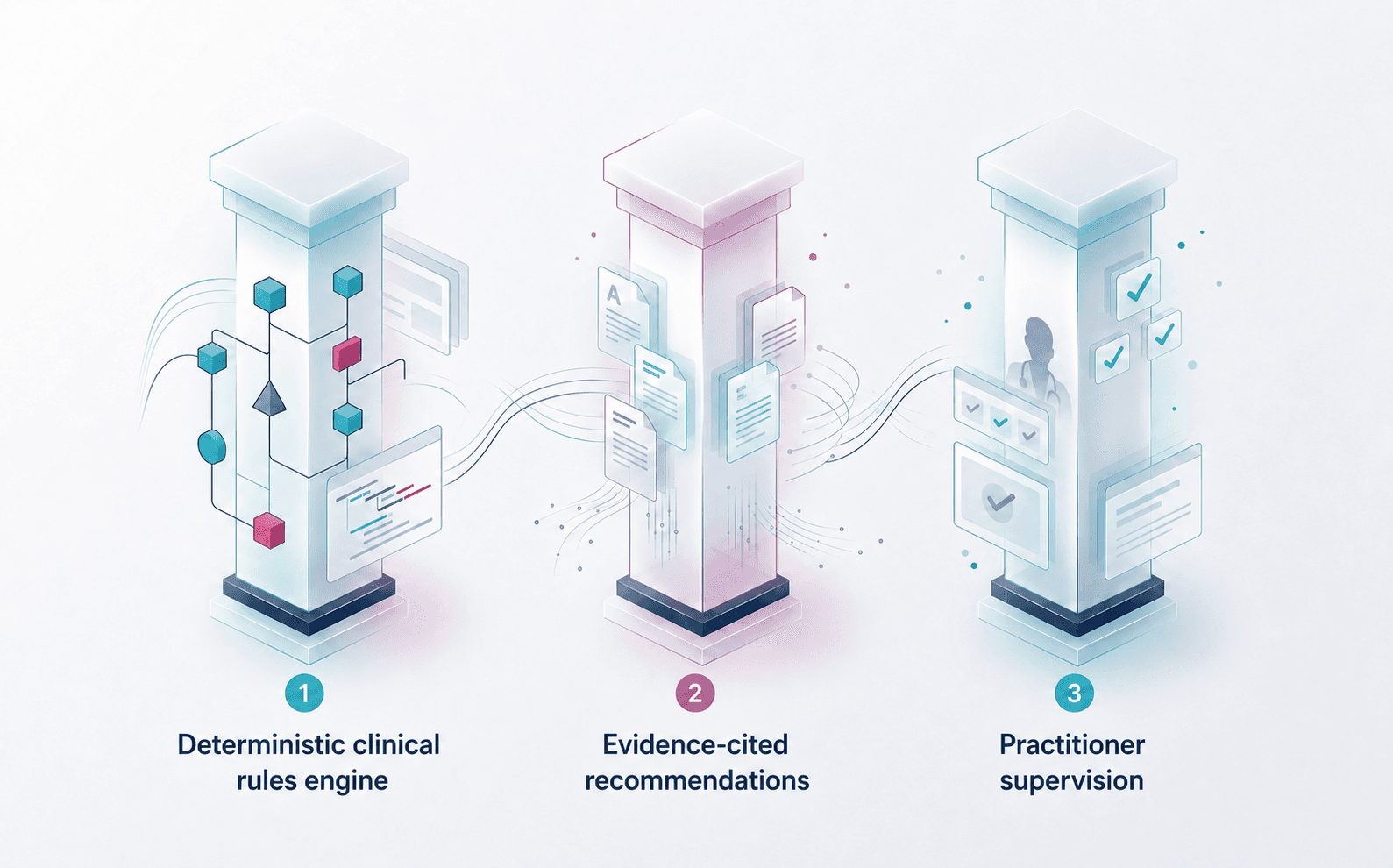
Tera's AI is not a black box. It is a safe, auditable system for three structural reasons:

  • Every output is practitioner-supervised

  • Clinically rule-anchored reasoning and protocols

  • Evidence-cited recommendations

— THE THREE SAFETY PILLARS —
01

Practitioner-supervised.

AI generates; the licensed clinician approves.

02

Clinically rule-anchored.

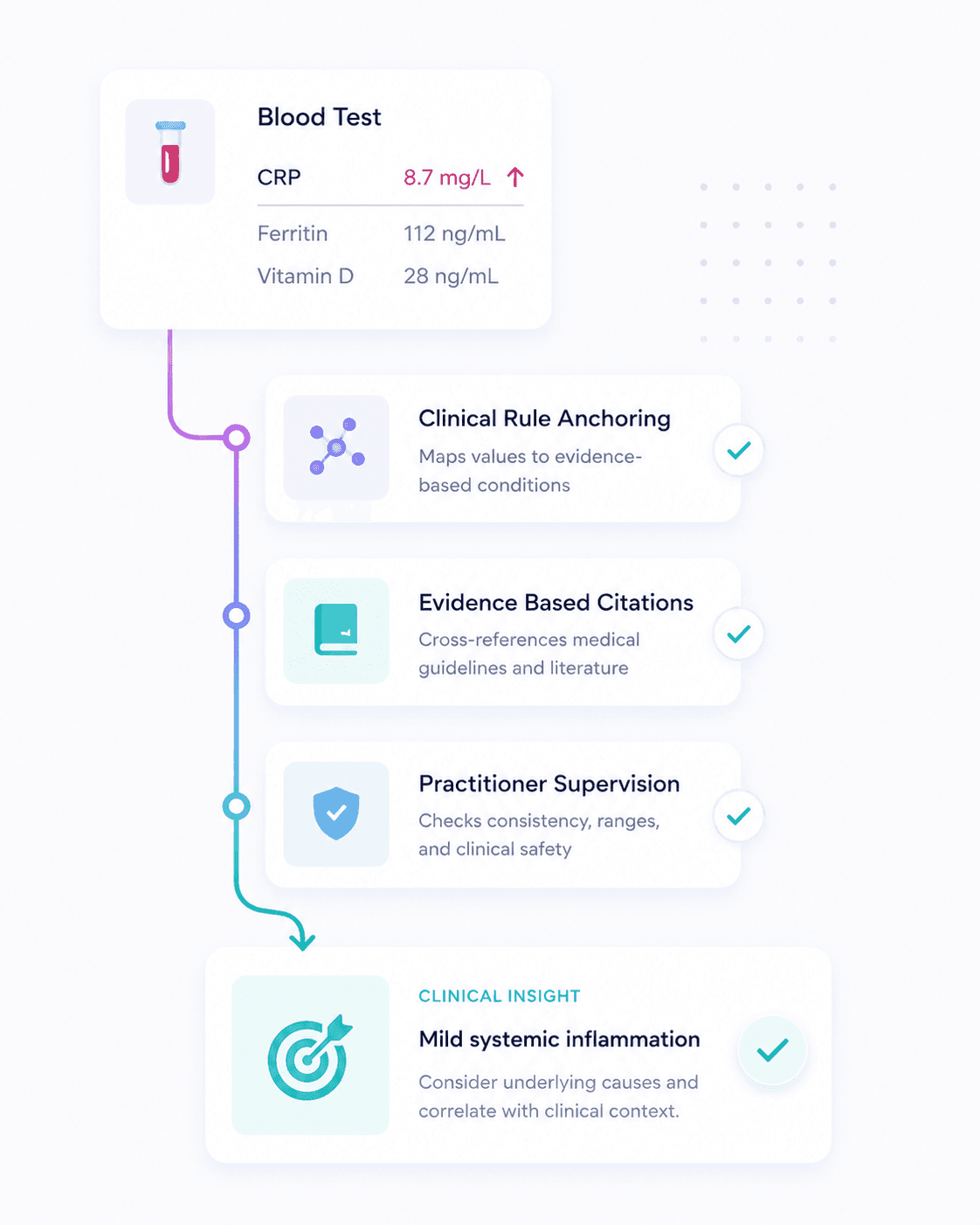
Reasoning and protocols run on deterministic rules; the LLM only summarizes.

03

Evidence-cited.

Every recommendation carries a peer-reviewed citation.

01Why LLMs alone are not enough
Why LLMs alone are not enough

Healthcare cannot run on AI that hallucinates.

Large language models are powerful — and brittle in exactly the ways healthcare cannot tolerate. Confident wrong answers. Drifting reasoning. No deterministic mapping from a blood value to a clinical interpretation. The risk is not theoretical. It is structural. Tera was engineered to remove those failure modes, not paper over them.

— Failure mode 01

Hallucinated clinical claims.

An LLM with no grounding will produce plausible-sounding interpretations of biomarker data that are subtly wrong. Healthcare cannot accept "subtly wrong."

— Failure mode 02

Non-deterministic reasoning.

The same lab panel can produce different LLM outputs on different days. Clinical decisions need repeatability, not creativity.

— Failure mode 03

No audit trail.

If a recommendation cannot be traced to a specific rule and a specific citation, it cannot be defended in a clinical review.

— Failure mode 04

No supervision layer.

"Autonomous" healthcare AI shifts liability to the patient. Tera's design keeps the licensed practitioner accountable — and in control.

02The three pillars
The three pillars

Three structural safety pillars. Not three features.

Tera's safety properties are architectural, not bolted on. Each pillar removes a specific class of failure mode that pure-LLM systems can't address — and together they form an AI that a clinician can supervise, an enterprise can embed, and a regulator can audit.

01
— Pillar 01 —

Practitioner-supervised,
where care happens.

Clinical reasoning and protocol output is practitioner-supervised. The system generates. The coach and licensed clinician approve before protocols become part of the patient's care plan.

In TeraPro

The clinical reasoning engine surfaces a ranked possible condition. The practitioner confirms, edits, or dismisses. Protocols draft only after confirmation. Every change is logged.
02
— Pillar 02 —

Clinically rule-anchored.
Deterministic where it counts.

Reasoning and protocols are clinical rule-anchored, not LLM-improvised. A proprietary clinical knowledge base maps biomarkers, wearable metrics, and patient context to functional ranges and to likely conditions and evidence-based protocols deterministically: the same inputs produce the same clinical interpretation every time. The large language model does not interpret values. It summarizes findings the rules engine produces.

This is the structural answer to the hallucination problem: the AI cannot "make something up" about a lab value because the lab value is interpreted by code (a value maps to a condition which maps to a protocol), not by a model.

Under the hood

Hundreds of biomarkers map to conditions and protocols through versioned, auditable rules. The same panel today, the same panel next year — same clinical interpretation.

03
— Pillar 03 —

Every recommendation is Evidence-cited.

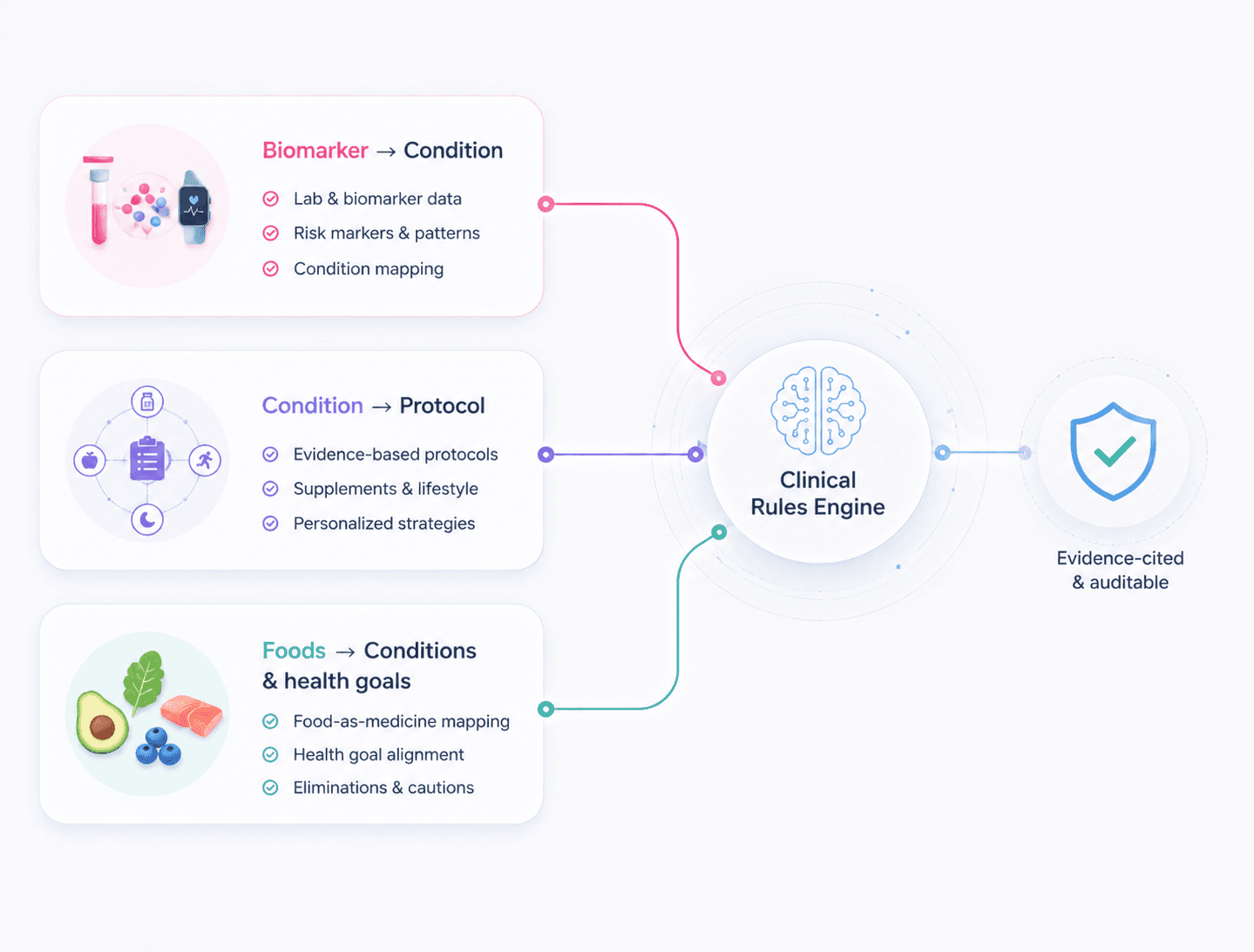
Every clinical insight and protocol recommendation carries a peer-reviewed scientific citation, inspectable from inside the clinical reasoning summary and the protocol. Across the three knowledge bases below — biomarker→condition, condition→protocol, and food → conditions and health goals — every clinical claim Tera makes traces back to a published source.

If a recommendation cannot be defended in front of a clinical reviewer, it cannot be defended in front of a patient. Citations make every output reviewable, not opaque.

For the practitioner

Click any line of a protocol to inspect the citations behind it. Edit or override with the evidence in front of you — never blind.

03The proprietary clinical knowledge bases
The proprietary clinical knowledge bases

Three proprietary knowledge bases. One auditable system.

Tera's safety architecture rests on the clinical data underneath. Three curated knowledge bases — each versioned, peer-reviewed, and citable — power the rules engine that interprets every clinical insight and protocol.

— Knowledge base 01

Biomarker → Condition

Hundreds of biomarkers and wearable data metrics (blood, gut, inflammation, cardiovascular, hormonal, metabolic, epigenetic, sleep, stress, …) mapped deterministically to possible conditions, with functional ranges drawn from published clinical literature.

— Knowledge base 02

Condition → Protocol

Conditions mapped to evidence-cited protocols across the seven lifestyle domains (nutrition, supplements, fitness, sleep, stress, recovery, exposures) — composed to work together, not in conflict.

— Knowledge base 03

Foods → Conditions & health goals

The food-as-medicine graph: 1,000+ whole and slightly processed foods mapped to the conditions and health goals they support, enabling personalized medicinal meal plans that support the patient's clinical context.

05Trust by architecture

Safe AI is built in, not bolted on.

Practitioner-supervised. Clinically rule-anchored. Evidence-cited.
Three structural safety pillars, every layer of the platform — from TeraPro to the Tera Patient Copilot to the Tera AI Clinical Copilots embedded in enterprise products via APIs and SDKs.